

The Gottmans’ Sound Relationship House
The Sound Relationship House- A Framework for a healthy Relationship
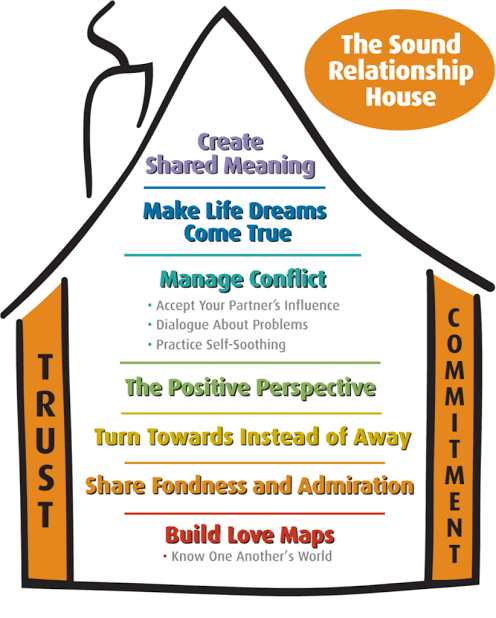
The Sound Relationship House Theory is the central framework developed by John Gottman and Julie Schwartz Gottman. It is based on decades of observational research into what makes relationships thrive or fail.
The model imagines a healthy relationship as a house. Each level supports the one above it, while two “weight-bearing walls” provide stability throughout.
Below is a detailed guide to each element and how to help couples build it.
The Foundation: Build Love Maps
Love Maps are your internal map of your partner’s inner world.
This means continually knowing:
their worries
dreams
current stresses
favourite things
ambitions
friendships
childhood experiences
current work pressures
values
health concerns
what they’re excited about right now
Many couples know these things when they first meet but stop updating them.
Why it’s important
People constantly change.
If you stop learning your partner, you gradually become strangers living alongside each other.
Love Maps create:
intimacy
empathy
friendship
emotional safety
How to build them
Have regular conversations about:
“What’s been on your mind today?”
“What are you looking forward to this month?”
“What’s stressing you lately?”
“How are things with your family?”
“What’s something you’d like us to do together?”
The Gottmans recommend curiosity over assumption.
Never assume you already know your partner.
First Floor: Share Fondness and Admiration
This is the antidote to contempt.
Happy couples deliberately notice what they appreciate.
They actively think:
“What do I admire about them?”
“What am I grateful for?”
“What attracted me in the first place?”
Why it matters
Negative interactions naturally become more memorable.
Without intentional appreciation, criticism slowly replaces admiration.
Admiration acts like emotional insulation during conflict.
How to strengthen it
Daily gratitude.
Examples:
Thank your partner for small things.
Remember happy memories.
Tell them specific qualities you value.
Speak positively about them to other people.
Express affection often.
The Gottmans discovered that relationships failed if their positive interactions fell below a ratio of roughly 5 positive interactions for every 1 negative interaction during ordinary relationship life.
However, I believe that a happy-enough relationship will need a ratio of at least 50: 1 to feel consistently emotionally safe.
Second Floor: Turn Towards Instead of Away
Perhaps the most powerful concept in the entire model.
Partners constantly make bids for connection.
A bid might be:
“Look at this.”
A sigh.
A smile.
A joke.
Touching your arm.
Asking a question.
Sharing something about work.
Each bid gives three options:
Turn Towards
Respond positively.
Example:
“I’d love to hear.”
Turn Away
Ignore.
Continue scrolling your phone.
Turn Against
Respond negatively.
“I haven’t got time.”
Thousands of these tiny moments determine relationship success more than grand romantic gestures.
How to improve
Notice bids.
Respond warmly.
Put devices down.
Show interest.
Even a brief response matters.
Third Floor: The Positive Perspective - “Positive Sentiment Override”
Once friendship is strong, couples begin giving each other the benefit of the doubt.
Instead of thinking:
“They’re selfish.”
they think:
“They’re probably stressed.”
Positive sentiment becomes the default lens.
Without it:
Neutral interactions become interpreted negatively.
For example:
Partner forgets milk.
Negative perspective:
“They never think about me.”
Positive perspective:
“They’ve had a hectic day.”
How to strengthen it
Repair conflicts quickly.
Assume good intentions.
Express appreciation frequently.
Keep emotional bank accounts full.
Fourth Floor: Manage Conflict
The Gottmans found that 69% of relationship problems are perpetual.
That means they are never completely solved.
Examples:
tidiness
spending
sex drive
in-laws
parenting
introversion vs extroversion
Successful couples manage these rather than trying to eliminate them.
Conflict management includes several skills.
1. Soft Start-up
Begin complaints gently.
Instead of:
“You never help.”
Say:
“I’m feeling overwhelmed and could use some help.” (Use the ‘I feel’ perspective).
The first three minutes often predict how the whole conversation will go.
2. Accept Influence
Especially in heterosexual relationships, the Gottmans found that when husbands are open to influence from their wives, relationship outcomes tend to be better.
In practice, this principle applies broadly: both partners benefit from being willing to consider each other’s perspectives rather than insisting on being right.
Accepting influence means saying:
“That’s a good point.”
“I hadn’t thought about it like that.”
3. Self-soothe
Arguments become unproductive when heart rate rises significantly.
Signs include:
racing heart
tunnel vision
inability to listen
defensiveness
The Gottmans recommend taking a break of around 20 minutes or longer when emotionally flooded, using that time to genuinely calm down (rather than rehearse arguments), before returning to the discussion.
4. Repair Attempts
Repairs stop conflict escalating.
Examples:
“I’m sorry.”
“Can we start again?”
“I understand.”
“Let’s slow down.”
“I know we’re both upset.”
Successful couples constantly repair.
5. Avoid the Four Horsemen
The Gottmans identified four behaviours strongly associated with relationship distress:
Criticism – attacking character rather than describing a behaviour.
Contempt – sarcasm, mockery, eye-rolling, insults; this is the strongest predictor of relationship breakdown.
Defensiveness – refusing responsibility or counter-attacking.
Stonewalling – emotionally withdrawing or shutting down during conflict.
Instead, aim for gentle complaints, appreciation, taking responsibility where appropriate, and self-soothing before re-engaging.
Fifth Floor: Make Life Dreams Come True
Healthy relationships help each partner become more fully themselves.
Partners support each other’s:
ambitions
creativity
education
career
hobbies
spirituality
identity
meaning
How
Ask:
“What dream matters most to you?”
“What can I do to help?”
Celebrate progress.
Be a safe place for vulnerability.
Sixth Floor: Create Shared Meaning
This is the top of the house.
It involves creating a relationship culture unique to the couple.
This includes:
Shared rituals
Examples:
Friday takeaway
Sunday walks
bedtime routines
anniversary traditions
Shared goals
Such as:
retirement plans
raising children
travel
volunteering
financial priorities
Shared values
Examples:
kindness
honesty
adventure
family
faith
generosity
Shared identity
Couples begin thinking:
“This is who we are.”
The Two Weight-Bearing Walls
Trust
The Gottmans define trust as acting and thinking in ways that communicate, “You have my best interests at heart.”
Trust is built through consistent everyday choices:
reliability
honesty
emotional responsiveness
keeping promises
transparency
choosing the relationship over momentary self-interest
Trust grows through many small moments rather than one grand gesture.
Commitment
Commitment means actively choosing the relationship every day.
It includes:
protecting the relationship from outside threats
speaking positively about your partner
investing time and energy
working through difficulties
maintaining a long-term perspective
Commitment is not just staying together; it’s nurturing the relationship over time.
How the Levels Work Together
The model is cumulative:
Love Maps → Know each other deeply.
Fondness & Admiration → Maintain appreciation.
Turn Towards → Respond to bids for connection.
Positive Perspective → Give each other the benefit of the doubt.
Manage Conflict → Navigate inevitable differences constructively.
Make Life Dreams Come True → Support each other’s growth.
Create Shared Meaning → Build a life and identity together.
Trust and commitment support every level.